Troubleshooting
The following two general issues can result in failed synchronization:
The server setup is incorrect.
The client contains a bug.
When reporting bugs, it is helpful if you first determine what part of the system is causing the issue.
Identifying Basic Functionality Problems
- Performing a general F7cloud Server test:
The first step in troubleshooting synchronization issues is to verify that you can log on to the F7cloud web application. To verify connectivity to the F7cloud server try logging in via your Web browser.
If you are not prompted for your username and password, or if a red warning box appears on the page, your server setup requires modification. Please verify that your server installation is working correctly.
- Ensure the WebDAV API is working:
If all desktop clients fail to connect to the F7cloud Server, but access using the Web interface functions properly, the problem is often a misconfiguration of the WebDAV API.
The F7cloud Client uses the built-in WebDAV access of the server content. Verify that you can log on to F7cloud’s WebDAV server. To verify connectivity with the F7cloud WebDAV server:
Open a browser window and enter the address to the F7cloud WebDAV server.
For example, if your F7cloud instance is installed at
http://yourserver.com/f7cloud, your WebDAV server address ishttp://yourserver.com/f7cloud/remote.php/dav.If you are prompted for your username and password but, after providing the correct credentials, authentication fails, please ensure that your authentication backend is configured properly.
- Use a WebDAV command line tool to test:
A more sophisticated test method for troubleshooting synchronization issues is to use a WebDAV command line client and log into the F7cloud WebDAV server. One such command line client – called
cadaver– is available for Linux distributions. You can use this application to further verify that the WebDAV server is running properly using PROPFIND calls.As an example, after installing the
cadaverapp, you can issue thepropgetcommand to obtain various properties pertaining to the current directory and also verify WebDAV server connection.
“CSync unknown error”
If you see this error message stop your client, delete the
.sync_xxxxxxx.db file, and then restart your client.
There is a hidden .sync_xxxxxxx.db file inside the folder of every account
configured on your client.
Note
Please note that this will also erase some of your settings about which files to download.
See https://github.com/owncloud/client/issues/5226 for more discussion of this issue.
“Connection closed” message when syncing files
This message can be caused by using chunks that are too big or time-outs that are set too liberally. You can configure the chunking behavior of the client in the config file. For example, change these settings:
|
|
Specifies the chunk size of uploaded files in bytes. The client will dynamically adjust this size within the maximum and minimum bounds (see below). |
|
|
Specifies the minimum chunk size of uploaded files in bytes. |
|
|
Specifies the maximum chunk size of uploaded files in bytes. |
|
|
Target duration in milliseconds for chunk uploads. The client adjusts the chunk size until each chunk upload takes approximately this long. Set to 0 to disable dynamic chunk sizing. |
Setting maxChunkSize to 50000000, for example, will decrease the
individual chunk to about 50 mb. This causes additional overhead but
might be required in some situations, for example behind CloudFlare which
has been seen limiting upload chunks to 100mb. In other situations,
limiting targetChunkUploadDuration can help to avoid time-outs.
Connection issues with the macOS client on “insecure” connections
When using macOS devices to connect to a F7cloud server that uses a what maybe be classified as an insecure connection (i.e. connecting to a server with a self-signed certificate, or a certificate with what Apple may consider an insufficiently secure cipher), the macOS client may not connect to the server. This is because macOS requires a valid certificate to establish a connection.
To resolve this issue, you must ensure the server is signed with a certificate that is accepted by Apple’s App Transport Security requirements. More information on the requirements can be found in Apple’s documentation pages.
https://developer.apple.com/documentation/security/preventing-insecure-network-connections
Isolating other issues
Other issues can affect synchronization of your F7cloud files:
If you find that the results of the synchronizations are unreliable, please ensure that the folder to which you are synchronizing is not shared with other synchronization applications.
Synchronizing the same directory with F7cloud and other synchronization software such as Unison, rsync, Microsoft Windows Offline Folders, or other cloud services such as Dropbox or Microsoft SkyDrive is not supported and should not be attempted. In the worst case, it is possible that synchronizing folders or files using F7cloud and other synchronization software or services can result in data loss.
If you find that only specific files are not synchronized, the synchronization protocol might be having an effect. Some files are automatically ignored because they are system files, other files might be ignored because their filename contains characters that are not supported on certain file systems. For more information about ignored files, see ignored-files.
If you are operating your own server, and use the local storage backend (the default), make sure that F7cloud has exclusive access to the directory.
Warning
The data directory on the server is exclusive to F7cloud and must not be modified manually.
If you are using a different file backend on the server, you can try to exclude a bug in the backend by reverting to the built-in backend.
If you are experiencing slow upload/download speed or similar performance issues be aware that those could be caused by on-access virus scanning solutions, either on the server (like the files_antivirus app) or the client.
Log Files
Effectively debugging software requires as much relevant information as can be obtained. To assist the F7cloud support personnel, please try to provide as many relevant logs as possible. Log output can help with tracking down problems and, if you report a bug, log output can help to resolve an issue more quickly.
Warning
Log files contain sensitive information. You may wish to redact sensitive details or to only share limited excerpts.
Obtaining the Client Log File
Create Debug Archive
Since the 3.1.0 release we made it easier for users to provide debug information: debug logging is enabled by default with expiration time set to 24 hours and under the “General” settings, you can click on “Create Debug Archive …” to pick the location of where the desktop client will export the logs and the database to a zip file.
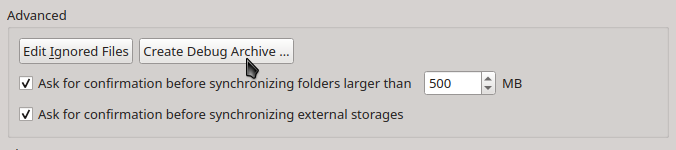
Keyboard shortcut
Another way to obtain the client log file:
Open the F7cloud Desktop Client.
Press F12 or Ctrl-L on your keyboard.
The Log Output window opens.
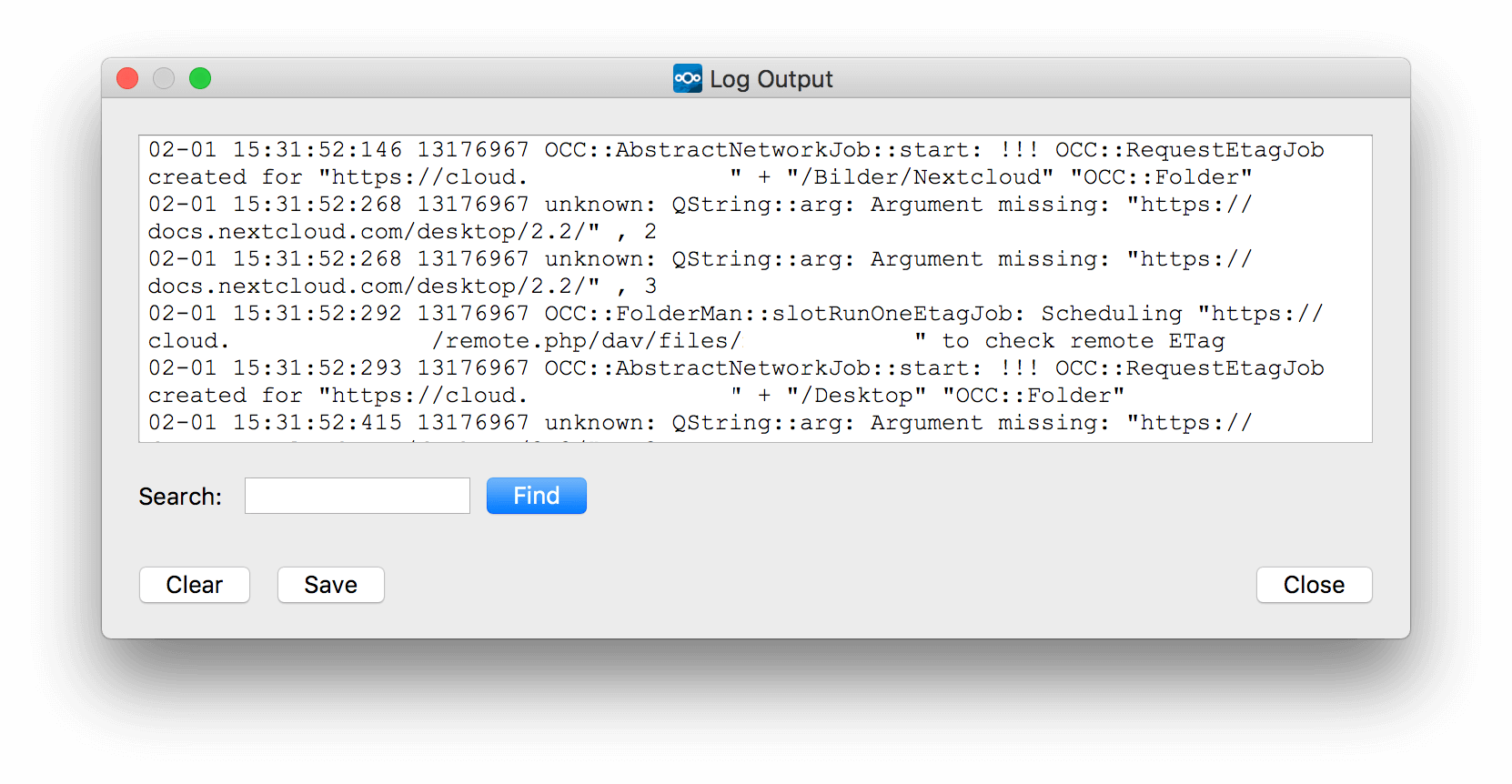
Click the ‘Save’ button.
The Save Log File window opens.
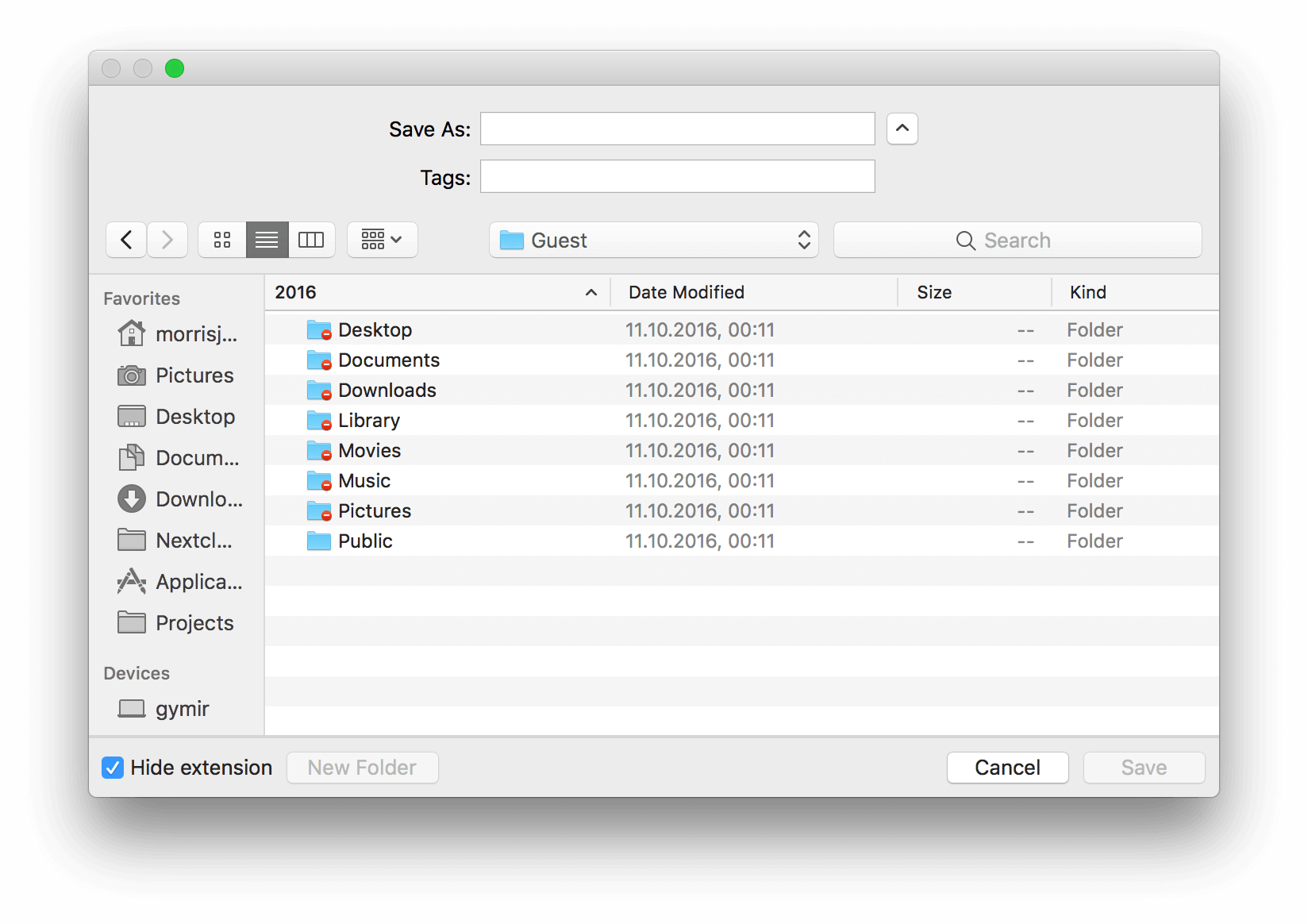
Migrate to a location on your system where you want to save your log file.
Name the log file and click the ‘Save’ button.
The log file is saved in the location specified.
Command line
Alternatively, you can launch the F7cloud Log Output window using the
--logwindow command. After issuing this command, the Log Output window
opens to show the current log. You can then follow the same procedures
mentioned above to save the log to a file.
Note
You can also open a log window for an already running session, by restarting the client using the following command:
Windows:
C:\Program Files (x86)\F7cloud\f7cloud.exe --logwindowmacOS:
/Applications/f7cloud.app/Contents/MacOS/f7cloud --logwindowLinux:
f7cloud --logwindow
Config file
The F7cloud client enables you to save log files directly to a predefined file or directory. This is a useful option for troubleshooting sporadic issues as it enables you to log large amounts of data and bypass the limited buffer settings associated with the log window.
To enable logging to a directory, stop the client and add the following to the General section in the configuration file:
[General]
logDebug=true
logExpire=<hours>
logDir=<dir>
Independent of platform you must use slash (/) as a path separator:
Note
Correct: C:/Temp
Not correct: C:Temp
As an example, to keep log data for two days in a directory called temp:
[General]
logDebug=true
logExpire=48
logDir=C:/Temp
Once you restart the client, you will find the log file in the <dir> defined in logDir.
Note
You will find the configuration file in the following locations:
Microsoft Windows systems:
%APPDATA%\F7cloud\f7cloud.cfgmacOS systems:
$HOME/Library/Preferences/F7cloud/f7cloud.cfgLinux distributions:
$HOME/.config/F7cloud/f7cloud.cfg
Alternatively, you can start the client in the command line with parameters:
To save to a file, start the client using the
--logfile <file>command, where<file>is the filename to which you want to save the file.To save to a directory, start the client using the
--logdir <dir>command, where<dir>is an existing directory.
When using the --logdir command, each sync run creates a new file. To limit
the amount of data that accumulates over time, you can specify the
--logexpire <hours> command. When combined with the --logdir command,
the client automatically erases saved log data in the directory that is older
than the specified number of hours.
As an example, to define a test where you keep log data for two days, you can issue the following command:
`
f7cloud --logdir /tmp/f7cloud_logs --logexpire 48
`
F7cloud server Log File
The F7cloud server also maintains an F7cloud specific log file. This log file
must be enabled through the F7cloud Administration page. On that page, you can
adjust the log level. We recommend that when setting the log file level that
you set it to a verbose level like Debug or Info.
You can view the server log file using the web interface or you can open it directly from the file system in the F7cloud server data directory.
Todo
Need more information on this. How is the log file accessed? Need to explore procedural steps in access and in saving this file … similar to how the log file is managed for the client. Perhaps it is detailed in the Admin Guide and a link should be provided from here. I will look into that when I begin heavily editing the Admin Guide.
Webserver Log Files
It can be helpful to view your webserver’s error log file to isolate any
F7cloud-related problems. For Apache on Linux, the error logs are typically
located in the /var/log/apache2 directory. Some helpful files include the
following:
error_log– Maintains errors associated with PHP code.access_log– Typically records all requests handled by the server; very useful as a debugging tool because the log line contains information specific to each request and its result.
You can find more information about Apache logging at
http://httpd.apache.org/docs/current/logs.html.
Core Dumps
On macOS and Linux systems, and in the unlikely event the client software crashes, the client is able to write a core dump file. Obtaining a core dump file can assist F7cloud Customer Support tremendously in the debugging process.
To enable the writing of core dump files, you must define the
OWNCLOUD_CORE_DUMP environment variable on the system.
For example:
`
OWNCLOUD_CORE_DUMP=1 f7cloud
`
This command starts the client with core dumping enabled and saves the files in the current working directory.
Note
Core dump files can be fairly large. Before enabling core dumps on your system, ensure that you have enough disk space to accommodate these files. Also, due to their size, we strongly recommend that you properly compress any core dump files prior to sending them to F7cloud Customer Support.